
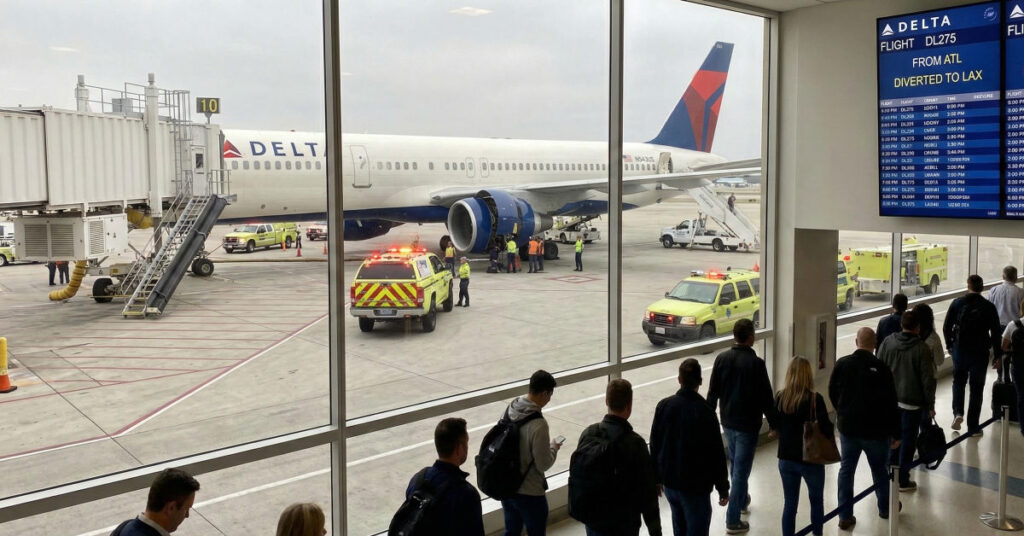
On May 28, 2025 Delta Air Lines Flight DL275—an Airbus A350 operating from Detroit to Tokyo Haneda—was unexpectedly diverted to Los Angeles International Airport after the crew detected a malfunction in the engine anti-ice system. Within the first moments of the alert, the crew made a decision that placed safety ahead of schedule, turning a trans-Pacific flight path toward the U.S. West Coast rather than continuing over remote oceanic airspace. This diversion became an example of aviation protocol working exactly as intended detect, assess, mitigate risk.
For many travelers, the incident raised immediate questions. Why LAX? What does an anti-ice malfunction actually mean? Was the aircraft at risk? And how do airlines prepare for contingencies involving long-haul aircraft far from suitable diversion airports?
This article examines the full timeline of the diversion, the technical explanation behind the engine system alert, and the broader implications for global aviation safety. Through detailed analysis, expert perspectives, structured comparisons, and a clear narrative, it aims to help readers understand not only what occurred aboard DL275—but why events unfolded the way they did, and what it reveals about flying in 2025.
The Flight, the Alert and the Decision to Divert
Delta Flight DL275 departed Detroit Metropolitan Wayne County Airport on schedule, heading toward Tokyo Haneda on a route that would take it over Canada, the Arctic fringe, and the expansive North Pacific. The Airbus A350-900, powered by Rolls-Royce Trent XWB engines, is designed for endurance, efficiency, and reliability. Yet several hours into the flight, cockpit systems flagged an anomaly in the engine anti-ice system—a critical safeguard against ice accumulation on engine inlets and aerodynamic surfaces.
The crew assessed the fault: abnormal airflow and bleed-air readings signaled that the component responsible for warming critical engine surfaces was no longer behaving predictably. A failure in this system is not merely an inconvenience; at altitudes where temperatures plunge far below freezing, engine icing can disrupt airflow, stall compressors, or reduce thrust symmetry.
Although Anchorage and Seattle were technically closer, the crew selected Los Angeles—an airport equipped with certified A350 maintenance facilities, specialized parts, and experienced technicians. The diversion was precautionary, deliberate, and aligned with long-haul safety regulations. At approximately 1:08 a.m. Pacific Time, the aircraft landed safely on LAX’s Runway 06R with emergency crews standing by as protocol, though no emergency was declared.
Why LAX Was the Optimal Choice
The crew’s decision to divert to Los Angeles was not arbitrary; it reflected a coordinated evaluation of distance, weather, equipment availability, and operational practicality. LAX is one of Delta’s major West Coast hubs, with maintenance teams certified to inspect and repair the Airbus A350 and its Rolls-Royce engines. Landing at a smaller airport, even one geographically closer, could have stranded the aircraft for days awaiting parts or certified expertise.
Choosing LAX ensured:
- Immediate access to specialized technicians
- Availability of engine components and diagnostic tools
- Large runways capable of accommodating a heavy A350
- Adequate passenger services, accommodations, and rebooking infrastructure
Operationally, the decision aligned with FAA and international aviation guidelines, which emphasize diverting to the “nearest suitable airport,” not merely the nearest geographically. Suitability includes runway length, maintenance capability, and safe approach options.
Understanding the Anti-Ice System Malfunction
Modern jet engines rely on a network of thermal and pneumatic systems to prevent ice accumulation on engine nacelles and fan inlets. In the A350’s Trent XWB engines, the anti-ice system redirects hot, compressed air to heat surfaces vulnerable to supercooled water droplets. If ice forms unchecked, it can disrupt airflow into the engine, triggering surges or thrust irregularities.
A malfunction may stem from:
- Sensor degradation
- Valve malfunction or seizure
- Air duct leakage
- Software anomalies
- Faulty temperature or pressure readings
Once the cockpit registered a fault, continuation over remote oceanic airspace would have pushed the aircraft outside acceptable safety margins. At the heart of the diversion was a simple premise: in long-haul flight operations, small anomalies can escalate when access to alternate airports becomes limited. The crew chose certainty over risk.
Passenger Experience and Immediate Aftermath
Upon landing, passengers reported a calm atmosphere. No emergency descent occurred; instead, the diversion resembled a controlled, professional rerouting. Emergency vehicles lined the runway as a precautionary measure, but no incident occurred on final approach or landing.
After arriving at the gate, passengers disembarked normally. Delta arranged hotel accommodations, rebooked itineraries to Tokyo, and provided meal vouchers. The aircraft remained grounded for approximately 18–24 hours to allow engineers to conduct diagnostics, repair the anti-ice system, and complete required safety checks.
Operational ripple effects included:
- Reassignment of A350 fleet assets
- Crew rescheduling
- Adjustments to other trans-Pacific departures
- Logistical pressure on maintenance teams
Despite these challenges, the airline’s response demonstrated procedural efficiency.
Broader Insights Into Aviation Risk Management
DL275’s diversion highlights the delicate interplay between technology, human judgment, and regulatory frameworks in long-haul aviation. Aircraft like the A350 are equipped with sophisticated monitoring systems, yet they remain dependent on precise mechanical components.
Three industry themes surfaced:
- Predictive Maintenance’s Growing Role
Airlines increasingly rely on advanced analytics and real-time engine monitoring. However, DL275 shows that even robust systems cannot catch every issue before it manifests. - The Value of Diversion Hubs
Airports like LAX serve as safety valves for long-haul operations, offering the maintenance depth needed for complex aircraft. - Human Judgment Remains Central
Despite automation, pilots and engineers interpret nuanced data and make decisions under uncertainty—especially over remote routes.
Expert opinions emphasize these points. Aviation specialists note that anti-ice failures over vast oceans warrant caution. Others highlight that even redundant systems require conservative decision-making when the consequences of in-flight system degradation are high.
Comparative Analysis of Diversions
Recent Diversions and Causes
| Flight | Route | Cause | Diversion Airport | Outcome |
| DL275 | Detroit → Tokyo | Engine anti-ice malfunction | Los Angeles | Safe landing, passengers rebooked |
| Long-haul example | Asia → U.S. | Hydraulic irregularity | West Coast hub | Aircraft grounded for inspection |
| Weather-based example | Various | Severe turbulence / storms | Nearest weather-safe airport | Route adjusted; passengers delayed |
This comparison shows that while weather-related diversions are more common, technical diversions like DL275 involve more complex decision frameworks and heavier operational impact.
Maintenance Capabilities and Operational Impact
Key Operational Considerations in Diversions
| Category | Explanation | Relevance to DL275 |
| Maintenance Infrastructure | Availability of A350-certified staff and parts | LAX offers full capability |
| Aircraft Weight & Fuel | Long-haul loads require longer runways | LAX meets performance needs |
| Passenger Handling | Ability to rebook hundreds of travelers | Large hub with robust staffing |
| Regulatory Compliance | Must land at nearest “suitable” airport | LAX chosen for suitability, not proximity |
Diversions are costly: fuel burn increases, crews accrue overtime, and delays ripple through networks. For airlines, a single long-haul diversion can cost millions—but the cost of not diverting when needed is exponentially greater.
Expert Perspectives
Aviation experts widely agree that DL275’s crew acted appropriately. Their analysis centers on three points:
- Anti-ice system importance: Specialists stress that these systems safeguard engine integrity as much as the engines themselves.
- Decision-making: Pilots are trained to treat anomalies conservatively over remote airspace, prioritizing safe diversion options.
- Maintenance strategy: Analysts suggest that periodic recalibration of component lifecycles may reduce future diversions, though no system is fail-proof.
These insights reflect a mature industry that continuously learns from operational events.
Long-Term Impacts and Industry Lessons
The DL275 diversion will likely shape maintenance protocols, particularly among airlines operating long-haul fleets. Engineers may revise inspection intervals for anti-ice components. Airlines may adjust which airports they designate as strategic diversion points, ensuring infrastructure aligns with fleet needs. Travelers may become more aware of the underlying complexity of long-distance flights, even as airlines increase transparency in reporting technical events.
For Delta, the incident reinforces the value of a distributed maintenance network and robust contingency planning. For the broader aviation industry, it serves as a reminder: even the world’s most advanced aircraft depend on thousands of mechanical, thermal, and digital components functioning in harmony. When one falters, systems and crews must respond seamlessly.
Takeaways
- DL275 was diverted due to an engine anti-ice malfunction—an essential safety system for high-altitude, long-haul flights.
- LAX was selected because of its specialized A350 maintenance facilities and operational readiness.
- Anti-ice systems protect engines from ice buildup that can disrupt airflow and reduce thrust stability.
- The landing was precautionary, with no injuries and calmly executed procedures.
- Predictive maintenance tools help reduce but cannot eliminate such incidents.
- Diversions carry significant financial and operational impacts, yet remain central to safety culture.
- The event highlights the partnership of technology and human judgment in modern aviation.
Conclusion
The diversion of Delta Flight DL275 was a vivid illustration of aviation safety functioning precisely as designed. Behind the calm landing and orderly disembarkation lay a complex series of decisions based on engineering, protocol, and experience. Long-haul aviation operates at the edge of technological and geographical limits, where the smallest anomalies can carry large implications. In this context, the rerouting of DL275 was not merely a delay—it was an affirmation of the industry’s commitment to safeguarding lives above convenience.
As global air travel continues to expand, incidents like this one remind passengers and professionals alike that aviation safety is a dynamic, ever-evolving system. Technology advances, predictive tools strengthen, and aircraft become more efficient, yet the foundation remains unshaken: a culture that places safety above all else. DL275 landed safely because that culture was upheld at every step—from cockpit alert to the final turn onto the LAX taxiway.
FAQs
Why did DL275 divert instead of continuing to Tokyo?
The engine anti-ice malfunction could worsen over remote oceanic airspace, risking engine performance and safety.
Why was Los Angeles chosen over Anchorage?
LAX had the required A350-certified maintenance capabilities and components necessary for inspection and repair.
Were passengers in danger during the flight?
No imminent danger occurred; the diversion was precautionary to maintain wide safety margins.
How long was the aircraft grounded?
Approximately 18–24 hours while maintenance teams conducted diagnostics and repairs.
Do modern aircraft still face such technical issues?
Yes. Despite advanced sensors and predictive systems, mechanical components can fail or degrade unpredictably.
References
Aero Online. (2025). Delta flight diverts due to engine issue.
https://aeroonline.net/delta-flight-diverts-due-to-engine-issue/?utm_source=chatgpt.com
Chandigarh City. (2025). Safety Tech Investigates Delta Flight DL275 Diverted LAX.
https://www.chandigarhcity.com/blog/2025/10/03/safety-tech-investigates-delta-flight-dl275-diverted-lax/?utm_source=chatgpt.com
Diving Daily. (2025). Unexpected Detour: Delta Flight DL275 Diverted to LAX.
https://divingdaily.com/delta-flight-dl275-diverted-lax/?utm_source=chatgpt.com
MashupMind. (2025). Delta Flight DL275 Diverted LAX After Engine Issue – Inside the Incident.
https://mashupmind.com/delta-flight-dl275-diverted-lax-inside-the-incident/?utm_source=chatgpt.com
OptinContacts. (2025). Delta Flight DL275 Diverts to LAX Over Engine Alert.
https://www.optincontacts.com/delta-flight-dl275-diverted-lax/?utm_source=chatgpt.com
TripGuiderz. (2025). Delta Flight DL275 Diverted LAX: Full Incident Report + Expert Analysis.
https://tripguiderz.com/2025/07/12/delta-flight-dl275-diverted-lax/?utm_source=chatgpt.com
Wolveyes.pk. (2025). Delta Flight DL275 Diverted LAX: A Definitive Guide.
https://wolveyes.pk/delta-flight-dl275-diverted-lax-guide/?utm_source=chatgpt.com
Picrew Travel Blog. (2025). What Happened on DL275 and Why It Diverted to LAX.
https://picrew.org/blog/travel/delta-flight-dl275-diverted-to-lax-what-happened-why-and-what-it-means/?utm_source=chatgpt.com